PHP2Shell: What Businesses and Digital Agencies Need to Know About the Critical PHP Vulnerability
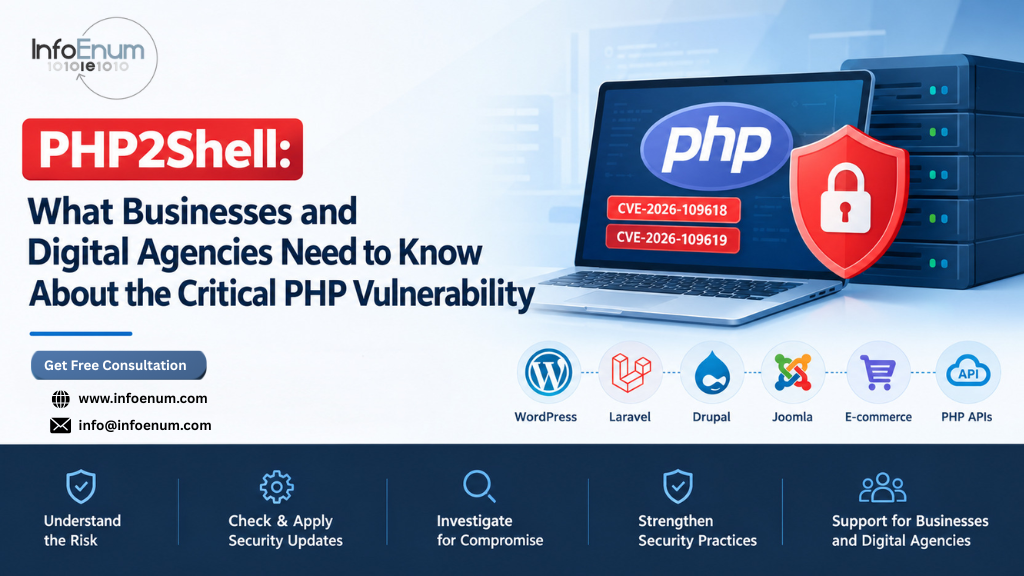
PHP powers millions of websites, business applications, e-commerce platforms and APIs. For businesses that rely on PHP, keeping the underlying technology secure is essential for protecting operations, customer information and business continuity.
On October 21, 2026, critical PHP vulnerabilities collectively referred to as PHP2Shell were publicly disclosed alongside security updates. The vulnerabilities, tracked as CVE-2026-109618 and CVE-2026-109619, can potentially allow remote code execution on vulnerable PHP servers.
For businesses, the immediate priority is to determine whether their PHP environments are affected, apply the appropriate security updates and investigate any signs of compromise.
For digital agencies and software development companies managing multiple client applications, this is also a reminder to review security maintenance processes across their entire portfolio.
What Is PHP2Shell?
PHP2Shell refers to two critical vulnerabilities in the PHP runtime.
- CVE-2026-109618: A memory-handling flaw involving out-of-memory conditions during request processing.
- CVE-2026-109619: A flaw involving stale internal state that can persist after the memory it references has been freed.
Under certain conditions, these flaws can be exploited to execute code on a vulnerable server. The risk depends on the affected PHP build, deployment environment and relevant conditions.
Unlike a vulnerability limited to a particular WordPress plugin or application feature, these issues affect the PHP runtime itself. Consequently, application-level authentication alone may not prevent an attack that occurs before application code handles a request.
Official references:
- PHP security release information: https://www.php.net/archive/2026.php
- CVE-2026-109618: https://github.com/php/php-src/security/advisories/GHSA-w8hw-w9fx-j79w
- CVE-2026-109619: https://github.com/php/php-src/security/advisories/GHSA-6wmf-4rv5-p3rp
Which Websites Could Be Affected?
PHP2Shell is relevant to businesses running vulnerable PHP versions, regardless of which application framework they use.
Potentially affected environments include:
- WordPress websites and WooCommerce stores
- Laravel applications and custom PHP software
- Drupal and Joomla websites
- E-commerce platforms and customer portals
- PHP-based REST APIs and SaaS applications
- Applications running PHP through Apache, PHP-FPM, containers or cloud infrastructure
The presence of one of these platforms does not automatically mean a website is vulnerable. The actual PHP runtime and vendor security status must be checked.
What Could Happen If a Vulnerable Server Is Exploited?
Successful remote code execution can have serious consequences, depending on the permissions available to the affected service.
Potential consequences include:
- Unauthorized access to application files and configuration
- Exposure of database credentials or API secrets accessible to the service
- Installation of malicious files or unauthorized modifications
- Attempts to move deeper into the hosting environment
- Website disruption, service downtime and recovery expenses
- Potential exposure of customer or business information
These are potential consequences, not proof that every vulnerable server has been compromised. Businesses should avoid assuming either that they have been attacked or that they are safe without checking the evidence.
What Should Businesses Do Now?
1. Identify every PHP environment
Start by inventorying websites, APIs, application servers, container images, staging systems and deployment pipelines. A company may have multiple PHP versions running across different environments.
Checking only the main website may leave other applications exposed.
2. Verify the PHP version and security patch
The PHP project has published fixed releases for supported branches, including:
- PHP 8.5.12
- PHP 8.4.27
- PHP 8.3.36
- PHP 8.2.35
These versions were identified as the initial fixed releases for their respective branches. Confirm the current vendor advisory and operating-system or hosting-provider backports before upgrading.
Older unsupported branches may require a vendor-provided patch or migration to a supported release. A version number alone may not tell the full story when a hosting provider backports security fixes.
3. Apply the update safely
Before deployment, take appropriate backups and test the update in a staging environment where possible.
Verify application compatibility, PHP extensions, database connectivity, scheduled tasks, payment flows and API integrations. After testing, deploy the fix, restart relevant services where required, and confirm that the intended PHP runtime is actually in use.
4. Investigate possible compromise
Updating PHP reduces exposure to the known vulnerability, but it does not automatically remove an attacker who may already have gained access.
Review available server, web-server, PHP-FPM, authentication and application logs. Investigate unusual errors, unexpected file changes, unfamiliar processes, suspicious outbound connections and unauthorized account activity.
If compromise is suspected, involve a qualified incident-response professional. Preserve relevant evidence and follow a documented containment and recovery process.
5. Strengthen ongoing security practices
PHP patching should be part of a broader maintenance programme that includes:
- Regular security updates and dependency reviews
- Least-privilege permissions and separation of environments
- Verified, restorable backups
- Monitoring and log retention
- Secure handling of credentials and secrets
- Periodic vulnerability assessments
- Documented incident-response and recovery procedures
Why Digital Agencies Should Review Their Client Portfolios
Digital agencies often manage many websites built at different times, using different frameworks, hosting providers and PHP versions.
During a critical security incident, identifying every affected environment and coordinating updates across clients can consume significant technical resources.
Agencies can reduce this pressure by maintaining an accurate inventory of client applications, documenting their PHP versions, defining an emergency patching process and establishing a trusted technical partner for additional development capacity.
For agencies without a dedicated internal security team, an experienced PHP development partner can help with application inventory, patch deployment, compatibility testing and ongoing maintenance. Complex incident response should be handled by suitably qualified specialists.
How InfoEnum Software Systems Can Help
InfoEnum Software Systems has provided IT services since 2014, supporting businesses with web applications, custom software development and application maintenance.
We can discuss support for PHP-based websites and applications, including:
- PHP and Laravel application reviews
- PHP version and patch-readiness assessments
- Security update implementation and compatibility testing
- WordPress and custom application maintenance
- Regression testing and post-update validation
- Ongoing development and maintenance support
- White-label development assistance for digital agencies, subject to an agreed scope
The exact service scope depends on the application, hosting environment and level of security expertise required. Where forensic investigation or specialist incident response is necessary, we recommend involving a qualified cybersecurity partner.
Need Help Reviewing Your PHP Applications?
If your business operates PHP-based websites or your agency manages applications for multiple clients, now is a good time to review your PHP environments and patch status.
Contact InfoEnum Software Systems to discuss your application inventory, PHP maintenance requirements or white-label development support.
Website: https://www.infoenum.com/
Let’s work together to keep your applications maintained, reliable and better prepared for future security incidents.