AI Implementation for Sensitive Data: A Security-First Approach
AI is transforming every industry — healthcare, fintech, legal, HR, enterprise SaaS. When your platform handles sensitive information, the challenge isn’t just building AI that works — it’s building AI that users, regulators, and enterprises can trust.
AI Is Powerful, But So Is the Risk
Organizations are integrating AI to automate workflows, power recommendations, summarize documents, and improve decisions. But not every application can simply send user data to a public Large Language Model (LLM).
If your application processes:
- Personally Identifiable Information (PII)
- Patient health records
- Financial transactions
- Legal documents
- Employee information
- Intellectual property
- Confidential business data
then security cannot be an afterthought. A single insecure integration can expose sensitive data and permanently damage customer trust.
The question is no longer “How do we add AI?” — it’s “How do we implement AI without compromising security and privacy?”
Why Traditional AI Integration Isn’t Enough
Many teams connect directly to a public LLM through an API — fine for generic content, risky with sensitive information.
Common risks include:
- Sensitive prompts leaving your infrastructure
- PII being unintentionally exposed
- Lack of visibility into how data is processed
- Regulatory compliance challenges
- Unauthorized access to AI-generated insights
- Data leakage through logs or prompts
As AI capabilities grow, so does the attack surface — a security-first architecture reduces these risks.
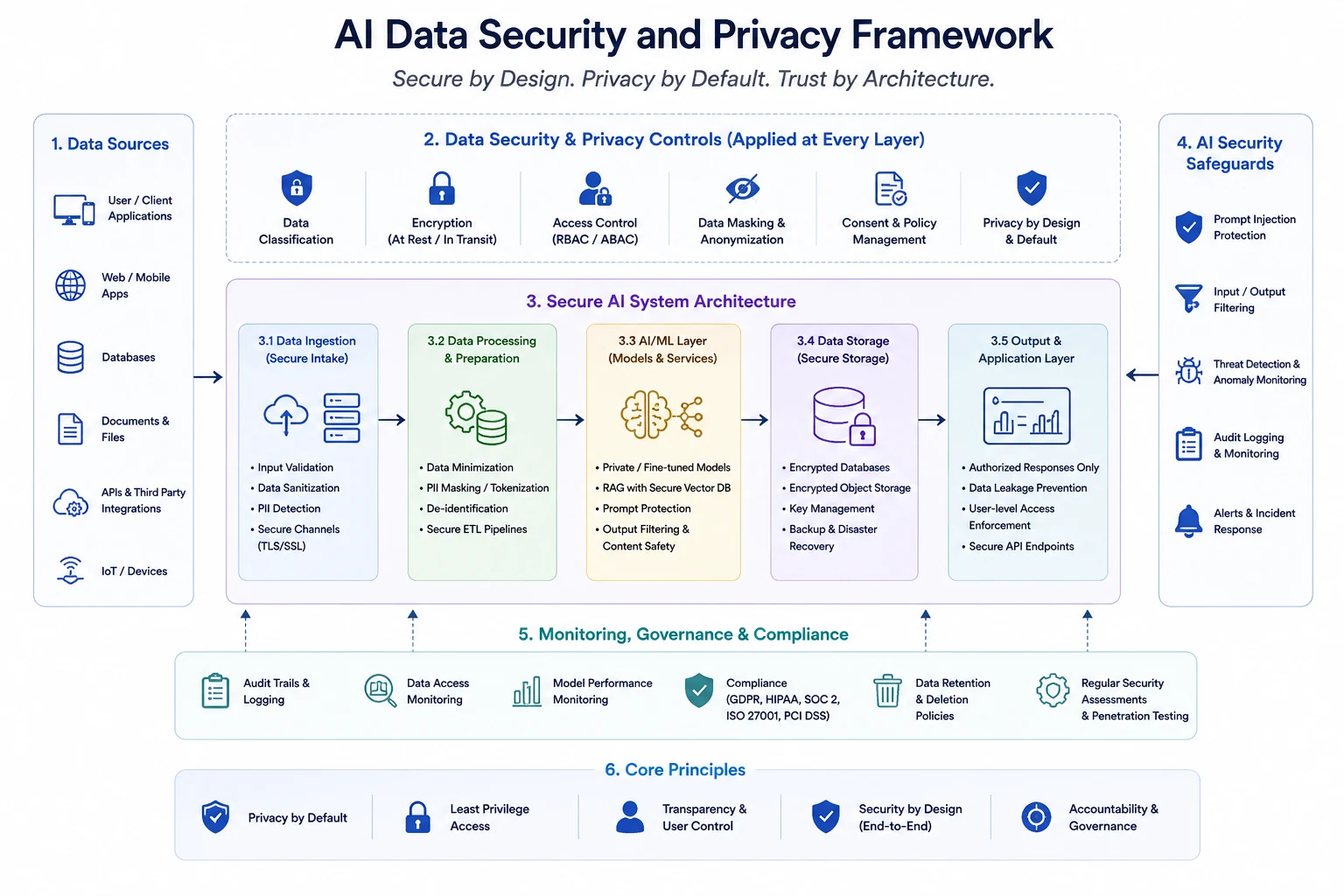
The Security-First AI Framework
Security should be built into every stage of implementation, not treated as a final checklist.
1. Classify Your Data Before Building AI
Not every piece of information should be treated equally. Categorize data as Public, Internal, Confidential, Highly Sensitive, or Regulated, then determine what the AI system actually needs — giving it more data than necessary is a common mistake.
Principle: Minimum Data Exposure
2. Choose the Right AI Architecture
Not every AI solution should rely on public models:
Public LLM APIs — for marketing content, documentation, and general productivity.
Retrieval-Augmented Generation (RAG) — ideal when AI must answer from your own knowledge base without retraining, keeping data in your control while staying accurate and current.
Private LLM Deployment — for strict compliance needs, deployed privately for full infrastructure control, stronger governance, and reduced exposure.
Choose architecture based on business risk, not popularity.
3. Protect Data Throughout Its Lifecycle
AI security extends beyond model selection. Implement end-to-end encryption (at rest and in transit), secure API communication, secret management, key rotation, and network isolation. Sensitive information should never travel unsecured.
4. Minimize AI’s Access
AI should never have unrestricted access to enterprise data. Adopt least privilege through Role-Based Access Control (RBAC), document-level permissions, and temporary access tokens. AI should only retrieve what the requesting user is already authorized to view — never a shortcut around your security model.
5. Remove Sensitive Information Before AI Processing
Where possible, mask PII, tokenize customer identifiers, remove unnecessary metadata, and anonymize datasets used for AI — reducing exposure before processing lowers risk significantly.
6. Build Secure Prompt Pipelines
Prompt engineering isn’t just better instructions — it’s protecting the system. Secure pipelines validate inputs, sanitize content, prevent prompt injection, and restrict access to confidential context. Prompt security is now a top priority in enterprise AI development.
7. Monitor Everything
Security doesn’t stop at deployment. Continuously monitor AI requests, user activity, API usage, prompt history, audit logs, and anomalous behavior. Strong logging strengthens security and simplifies audits and investigations.
Compliance Isn’t Optional
Depending on your business, your AI solution may need to align with GDPR, HIPAA, SOC 2, ISO 27001, and PCI DSS. Compliance should shape architecture from the start — not trigger an expensive redesign later.
Common Mistakes Organizations Make
- ❌ Sending sensitive customer data directly to public AI models
- ❌ Giving AI unrestricted database access
- ❌ Ignoring encryption for AI workflows
- ❌ No audit trail for AI decisions
- ❌ Missing access controls around AI-generated insights
- ❌ Assuming AI vendors automatically handle compliance
Technology alone doesn’t guarantee security — architecture does.
A Practical Security Checklist
Before launching AI in production, ask:
- Have we classified our data?
- Are we minimizing AI access?
- Is sensitive information encrypted?
- Do we sanitize prompts?
- Can we audit every AI interaction?
- Are users restricted by permissions?
- Have we evaluated regulatory requirements?
- Is customer data isolated from public models where necessary?
If any answer is “No,” the implementation is likely incomplete.
Final Thoughts
AI is rapidly becoming a competitive advantage, but success depends on more than the latest model. The most successful AI platforms are built on security, privacy, governance, and trust — a security-first approach doesn’t slow innovation, it enables it, letting organizations confidently adopt AI while meeting regulatory expectations and building for enterprise scale.
Build AI that is intelligent. Build AI that is secure. Most importantly, build AI that people can trust.
About the Author
At InfoEnum, we help startups and enterprises design and build secure, AI-powered web and mobile applications — spanning Generative AI, Agentic AI, Retrieval-Augmented Generation (RAG), enterprise SaaS, healthcare, and fintech, balancing innovation with security, compliance, and scalability.