SaaS Development Services in Australia: From Idea to Launch
Plenty of Australian businesses have a clever software idea sitting in a notebook somewhere. Maybe it’s a better way to manage bookings, a tool your industry has been crying out for, or a service you’d love to turn into a product. The hard part is knowing how to get from that idea to software people will happily pay for every month.
That’s where SaaS development services make the difference. With a clear plan and the right development partner, you can move from concept to a working SaaS platform without wasting time or budget. This guide walks you through the whole journey.
What Is SaaS Development?
SaaS (Software as a Service) development is the process of planning, designing, building and maintaining cloud software that customers access through a web browser or mobile app. Unlike traditional software, there’s nothing to install. Users simply sign up, pay a subscription and log in.
How SaaS Products Work
A SaaS product runs on cloud servers managed by the business that owns it. Every customer uses the same up-to-date version, and updates, backups and security are handled centrally. Compared with traditional software, which is usually bought once and installed on each computer, a SaaS application is easier to maintain and improve over time.
Why Businesses Choose SaaS Products
Customers like SaaS because it’s affordable to start, works on any device and grows with their needs. For the business building it, subscription-based software means steady, predictable revenue rather than one-off sales.
Why Australian Businesses Need SaaS Development Services
Creating Recurring Digital Services
Monthly or annual subscriptions give you a reliable income stream. That makes cash flow easier to manage and future growth easier to plan.
Reaching Customers Through Cloud-Based Software
Australia is a big country, and cloud-based SaaS solutions let you serve customers in Sydney, Melbourne, Perth or regional towns without opening new offices. The same product can also reach New Zealand and overseas markets.
Automating Business Processes
Many organisations still rely on spreadsheets, emails and paper forms. A well-built SaaS platform automates these tasks, saving hours each week and cutting down on costly mistakes.
Supporting Business Growth
Good SaaS software grows alongside your business. Adding users, features or new markets shouldn’t mean starting again from scratch.
SaaS Product Ideas for Australian Businesses
Business Management Platforms
Tools for quoting, scheduling, invoicing and job tracking are always popular, especially with tradies, cleaners and other service-based businesses.
Industry-Specific SaaS Applications
Sectors like aged care, NDIS services, construction, agriculture and allied health often need software built around their specific rules and workflows. Generic tools rarely fit them well.
Customer Relationship Management Software
A CRM tailored to one industry, such as real estate or hospitality, can outperform big-name options because it matches how those teams actually work.
Data and Analytics Platforms
Most businesses collect data but struggle to use it. Analytics platforms turn raw numbers into clear reports that support better decisions.
Key Features of a Successful SaaS Product
User Registration and Account Management
Sign-up should take seconds, not minutes. Users also need simple ways to update profiles, reset passwords and invite team members.
Subscription and Billing Management
Flexible plans, free trials, upgrades and automated invoicing are essential. For Australian customers, billing should handle AUD pricing and GST correctly.
Role-Based Access
An owner, a manager and a staff member shouldn’t all see the same information. Role-based access keeps sensitive data in the right hands.
Dashboards and Reporting
Clear dashboards show users what matters at a glance, while detailed reports support deeper analysis.
Third-Party Integrations
Customers expect your product to connect with the tools they already use, such as Xero, MYOB, HubSpot, Stripe or Slack.
Notifications and Communication
Email, SMS and in-app alerts keep users informed and encourage them to keep coming back.
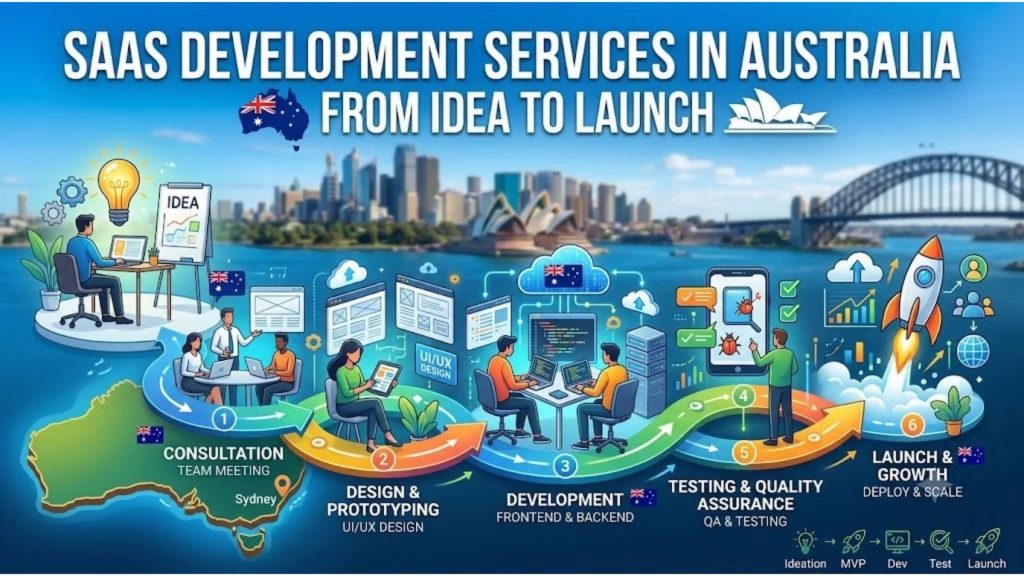
SaaS Development Process: From Idea to Launch
A clear SaaS development process keeps your project on track and avoids nasty surprises along the way.
1. Understanding the Business Idea
Everything starts with the problem you’re solving. We look at your goals, your market and how the product will make money.
2. Defining the Target Users and Requirements
Who will use the product, and what do they need most? Getting this right early shapes every decision that follows.
3. Planning the SaaS Product
This stage covers the feature list, MVP scope, SaaS architecture, technology stack, timeline and budget.
4. Designing the User Experience
Wireframes and clickable prototypes show how the product will look and feel before any code is written. Good design makes software easy to learn and enjoyable to use.
5. SaaS Application Development
Developers build the frontend, backend, database and integrations in short sprints, so you can review progress and give feedback regularly.
6. Testing and Quality Assurance
Every feature is tested for functionality, speed, security and usability across different devices and browsers.
7. Deployment and Cloud Setup
The product goes live on cloud infrastructure such as AWS, Microsoft Azure or Google Cloud. Many Australian businesses choose data centres in Sydney or Melbourne to keep customer data onshore.
8. Launching and Improving the Product
Launch day is only the beginning. Real user feedback guides updates, new features and ongoing improvements.
Technologies Used in SaaS Development
Modern SaaS products are usually built with frontend frameworks like React, Next.js or Vue.js, and backend technologies such as Node.js, Python, Laravel or .NET. Data is stored in databases like PostgreSQL, MySQL or MongoDB, and everything runs on cloud platforms that can scale on demand. More and more SaaS platforms are also adding AI features, including chatbots, smart recommendations and automated document processing. The right stack depends on your product, budget and long-term plans, not on what’s trendy.
SaaS Security and Data Protection in Australia
SaaS security isn’t optional, particularly for businesses handling personal, health or financial information. Australian businesses covered by the Privacy Act 1988 must follow the Australian Privacy Principles, and many also need to meet the Notifiable Data Breaches scheme.
A secure SaaS product should include multi-factor authentication, strict access controls, encryption for data in transit and at rest, secure API connections and regular security testing. Aligning with frameworks like the ACSC’s Essential Eight is also a smart move, especially if you plan to sell to government or larger enterprises.
How to Choose SaaS Development Services in Australia
Picking the right SaaS development company in Australia can make or break your product.
Check SaaS Development Experience
Building SaaS is very different from building a website. Look for a team that understands subscriptions, multi-tenant architecture and scalability.
Review Previous Projects and Case Studies
Past work shows what a team can genuinely deliver. Ask for examples similar to your idea or industry.
Understand the Development Process
A good partner explains how they plan, build, test and report progress. You should never feel left in the dark.
Evaluate Communication and Support
Regular updates, honest advice and quick responses matter just as much as technical skill.
Consider Long-Term Product Development
Your SaaS product will keep evolving. Choose a team that can support you well after launch, not one that disappears once the invoice is paid.
How InfoEnum Helps With SaaS Development
At InfoEnum, we offer SaaS product development services that cover the full journey, from early planning to ongoing growth.
Understanding Your SaaS Product Requirements
We start by getting to know your business, your customers and your goals, so the product solves the right problem from day one.
Building MVP and Full-Scale SaaS Products
Our SaaS MVP development helps you launch quickly and test your idea with real users. Once it’s proven, we expand it into a complete, feature-rich platform.
Developing Scalable SaaS Architecture
We design flexible, cloud-ready systems that handle growth smoothly, so you won’t need an expensive rebuild when your user base takes off.
Integrating SaaS With Existing Platforms
We connect your product with the accounting, CRM, payment and marketing tools your customers already rely on.
Supporting SaaS Products After Launch
Our team provides maintenance, security updates, performance monitoring and new feature development long after go-live.
Common Challenges in SaaS Product Development
Defining the Right MVP Scope
Trying to build everything at once delays launch and drains your budget. A focused MVP gets you to market faster and shows what customers really want.
Managing Product Complexity
As features pile up, products can become confusing. Careful planning keeps the experience simple and intuitive.
Ensuring Performance as Users Grow
Software that runs well for 50 users may struggle with 5,000. Planning for SaaS scalability early, through smart architecture, caching and cloud auto-scaling, avoids this headache.
Protecting Customer and Business Data
One data breach can damage customer trust for years. Security needs attention at every stage, not just before launch.
Managing Third-Party Integrations
External APIs change and occasionally fail. Integrations need proper error handling and monitoring to keep things running smoothly.
Frequently Asked Questions About SaaS Development
What are SaaS development services?
SaaS development services cover the planning, design, development, testing, launch and ongoing maintenance of cloud-based software sold on a subscription basis.
How long does it take to develop a SaaS product?
A simple MVP usually takes around three to four months. A full-featured SaaS platform can take six to twelve months or more, depending on its complexity and integrations.
How much does SaaS development cost in Australia?
Costs depend on the number of features, design complexity, integrations and security requirements. Starting with an MVP is the most cost-effective approach, as it lets you validate your idea before investing in the full product.
What is the difference between an MVP and a complete SaaS product?
An MVP includes only the core features needed to test your idea with real users. A complete SaaS product adds advanced features, integrations and refinements based on that feedback.
Does InfoEnum provide SaaS development services in Australia?
Yes. InfoEnum provides end-to-end SaaS development services for Australian businesses, including MVP development, custom SaaS platforms, integrations and post-launch support.
Conclusion
A SaaS product can turn a business idea into a cloud-based service that customers can use from almost anywhere. But building a successful SaaS application takes more than stitching features together.
Your product needs a clear purpose, a simple user experience, reliable infrastructure, strong security and an architecture that supports future growth.
With the right SaaS development services in Australia, you can move from an initial idea to an MVP and, eventually, a complete SaaS platform built around your customers and business goals.
InfoEnum helps Australian businesses plan, develop, integrate and improve SaaS applications from the first idea through launch and beyond. Got a SaaS idea you’d like to explore? Get in touch with InfoEnum and let’s talk about your next step.